

Case Study: Fibreco Redevelopment Project
About This Project
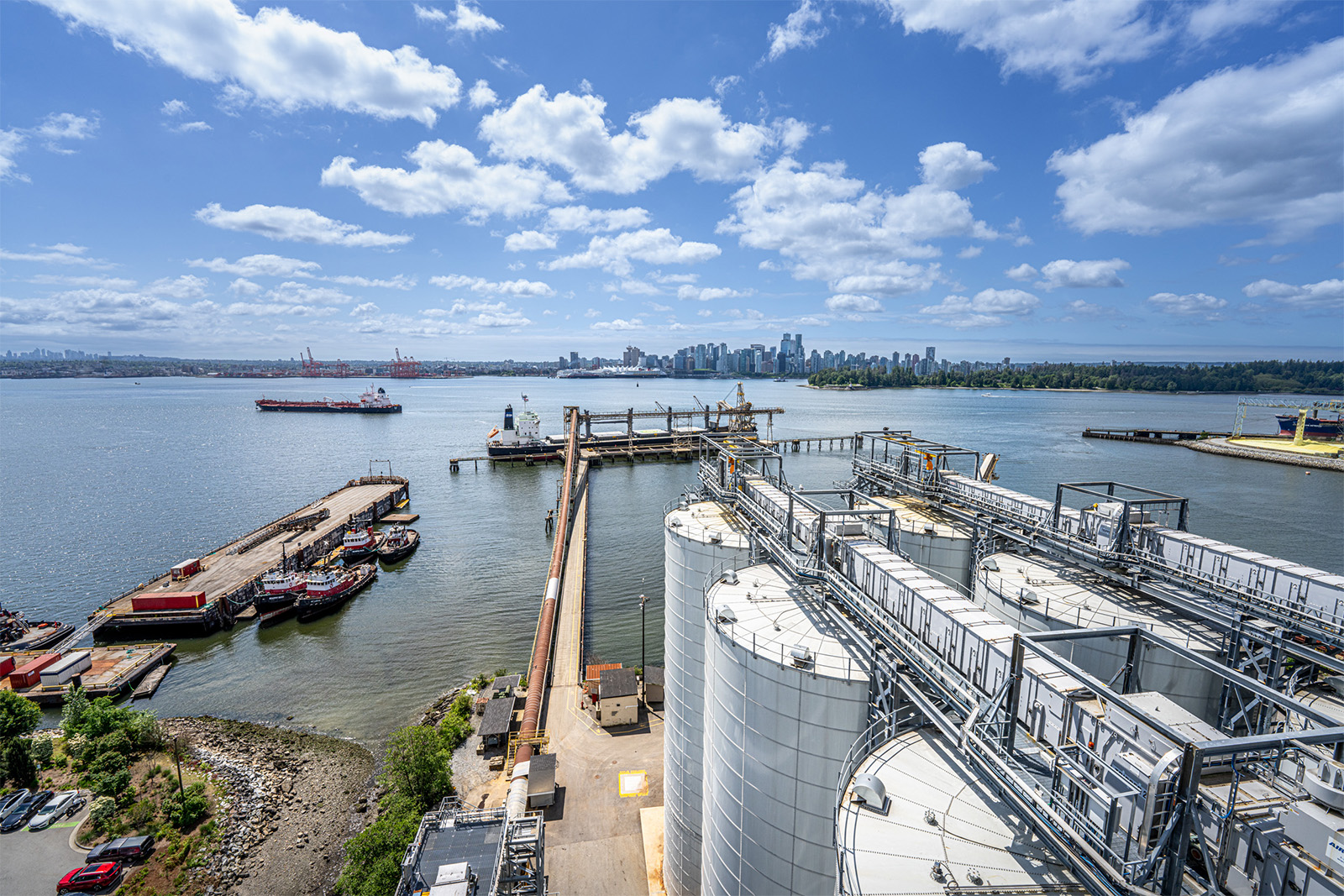
The Fibreco Redevelopment Project is a port upgrade initiative in North Vancouver that supports future grain export operations by sea. The project includes major improvements such as the installation of railcar indexer and dumper systems, expansion of rail yard facilities, upgrades and additions to conveyor systems, enhancements to dust collection systems, construction of new grain storage silos, and installation of a new shiploader along with modifications to the existing berth.
Due to the port’s proximity to long-established residential communities, including Norgate, and its closeness to Bodwell School in the Harbourside area, environmental noise was an important consideration during permitting with Vancouver Fraser Port Authority (VFPA) and in addressing the noise regulations of the District of North Vancouver (DNV).
BKL’s objective was to develop a clear understanding of the existing noise environment, simulate current and future noise conditions, and assess changes at noise-sensitive receptors. A key requirement for the project was to demonstrate that the redevelopment would not result in an overall increase in noise levels affecting the surrounding community.
Scope of Services
As the environmental acoustics consultant, and in response to requirements from both VFPA and DNV, BKL developed a structured scope of work focused on measurement, modeling, and noise impact assessment:
- Establishing assessment framework and study approach: BKL collaborated with Fibreco and stakeholders to identify requirements from VFPA and DNV, and reviewed relevant project information, including operational activities, capacity, and supply chain considerations. Based on this, a Terms of Reference was developed to guide the methodology and assessment approach.
- Baseline noise assessment: Using previously collected noise data from the Norgate residential area, combined with an additional week of measurements at Bodwell School in Harbourside, BKL established representative baseline conditions for the surrounding area.
- On-site source measurements: Key noise sources at the Fibreco site included rail operations (arrival, unloading, and departure), conveyors, the shiploader, and dust collection systems. In addition, unattended monitoring equipment was deployed to capture rail-related noise over multiple days, supported by operational data provided by Fibreco.
- Existing condition noise modeling: Using Cadna/A software, BKL developed a comprehensive noise model incorporating all major sources and accounting for sound propagation factors such as geometric spreading, atmospheric absorption, ground effects, and receptor elevation. Operational scenarios were defined using real data and reasonable assumptions.
- Future noise prediction and impact assessment: The model was updated to reflect post-redevelopment conditions, allowing prediction of noise levels at surrounding residential areas. Comparisons between existing and future scenarios were conducted using adjusted noise metrics, including tonal and impulsive characteristics, and considering specific sources such as rail wheel squeal and coupling impacts.
- Reporting and stakeholder engagement: BKL prepared a noise impact assessment report following recognized methodologies and criteria, participated in meetings with the client, and supported responses to regulatory inquiries.
- Post-construction verification testing: Following commissioning of key project components, including the shiploader, BKL conducted on-site noise measurements to verify the assumptions used in the environmental noise model. The measured sound levels were reviewed and compared with the predicted values to confirm the accuracy of the assessment and compliance with permit requirements.
Project Benefits
BKL’s approach supported the assessment and permitting process in several important ways:
- Reliable understanding of existing noise conditions: By combining measured data with modeling, the project established a strong foundation for characterizing the surrounding acoustic environment.
- Transparent and evidence-based impact assessment: Comparisons between “with project” and “without project” scenarios helped clarify the extent of potential noise changes at sensitive receptors and supported discussions with VFPA and DNV.
- Clear communication of technical information: Noise contour maps generated from the model helped illustrate the extent and magnitude of impacts in way that was easier for stakeholders to understand and discuss.
- Alignment with regulatory requirements: The scope of work was structured to support regulatory expectations, including demonstrating no net increase in overall community noise levels.
- Verification of modelling assumptions through field measurements: Post-construction noise measurements added confidence by confirming that the actual performance of key equipment, including the shiploader, was consistent with the original predictions.
Project Name:
Fibreco Redevelopment Project
Year Completed:
2021
Capital Cost:
$85 million