


12 May Controlling VAV Box Noise in Acute Care Hospital Design
Practical considerations for project teams working on healthcare facilities
In healthcare facilities, the acoustical environment plays an important role in supporting patient comfort, rest, and recovery. However, achieving low background noise levels can be challenging – particularly when HVAC systems rely on Variable Air Volume (VAV) boxes to control airflow.
At Acoustics Week 2024 in Montreal, Jessica Carolina, Acoustical Consultant at BKL, presented several strategies for managing noise from VAV boxes in acute care hospital projects. This article summarizes key considerations from that work, with the goal of helping contractors, engineers, and design teams better understand the factors that influence HVAC noise and how it can be addressed during design.
Why VAV Boxes Can Introduce Acoustical Challenges
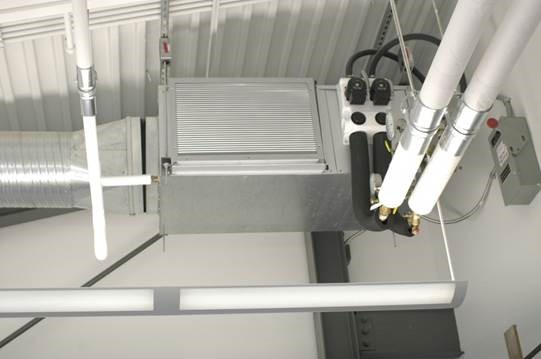
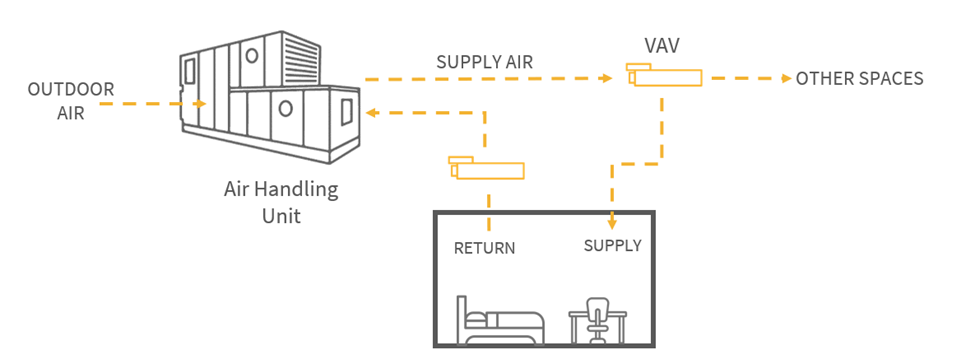
VAV boxes are commonly used in hospital HVAC systems to regulate airflow and temperature before conditioned air is delivered to individual spaces. Their ability to adjust air volume helps improve energy efficiency and maintain environmental control across different rooms.
However, these units generate noise, which may be of particular concern, especially when they are located close to acoustically-sensitive areas such as patient rooms.
In many healthcare projects, background noise criteria for acoustically sensitive spaces are specified in the range of NC 25-30, which is relatively stringent for building mechanical systems.
The most common and cost-effective method for attenuating noise within the duct system is the use of fibrous duct liners. However, due to infection control requirements, these liners cannot be used in hospital ductwork.
Due to infection control requirements, fibrous duct liners cannot be used in hospital ductwork. This removes the most common and cost-effective method for attenuating noise within the duct system.
In healthcare environments, HVAC systems must balance operational performance with strict acoustical requirements.
Understanding The Factors That Influence Background Noise
Noise from HVAC systems is rarely the result of a single component. Instead, the final sound level within a room is influenced by a combination of design factors, including:
- room size and geometry,
- ceiling construction,
- interior finishes and acoustical treatment,
- distance between equipment and occupied spaces,
- airflow rates and duct velocities,
- system pressure differences, and
- duct layout and configuration.
Due to multiple, and often competing, factors in play, addressing acoustical performance typically requires a system-level approach, rather than focusing on one piece of equipment alone.
Three Primary Noise Paths From VAV Boxes
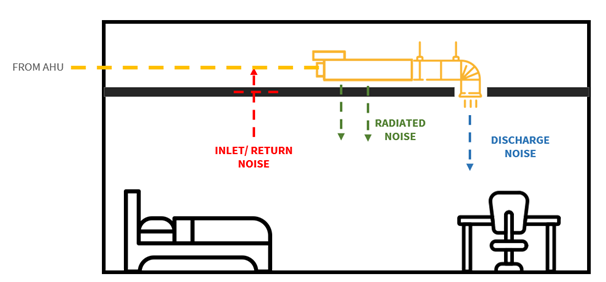
Noise generated by VAV boxes can reach occupied spaces through three main paths:
- Radiated noise – sound emitted directly from the equipment casing
- Discharge noise – sound transmitted through the supply air path
- Inlet or return noise – sound travelling through the return or inlet air path
Each of these paths may require different mitigation strategies depending on the system configuration.
Locating VAV boxes above ceilings
A common design question is whether VAV boxes can be installed directly above the ceiling of patient rooms.
Manufacturer data suggests that radiated noise levels may be acceptable in some situations, particularly when several conditions are met:
- VAV boxes include integrated attenuators;
- appropriately sized equipment is selected;
- systems operate at lower airflow rates and pressure differentials; and
- ceilings use gypsum board construction, which provides greater sound isolation than typical mineral fiber ceiling tiles.
Using VAV boxes with in-line attenuators can increase the likelihood that equipment can be placed above spaces requiring NC 25-30 without significantly increasing costs.
That said, actual performance still depends heavily on the operating conditions of the HVAC system.
Equipment selection and operating conditions can significantly influence whether VAV boxes can be located above acoustically-sensitive spaces.
Discharge and inlet noise: often the bigger challenge
In practice, discharge and inlet noise often present greater challenges than radiated noise.
When VAV boxes are located close to the spaces they serve, there may be insufficient duct length to allow natural sound attenuation before air reaches the room.
One commonly-used mitigation strategy is the use of fibreglass-insulated flexible ducts, which can provide additional attenuation – particularly in higher frequency ranges – while remaining within the allowable lengths specified in CSA Z317.2.
Where flexible ducts are not suitable, other strategies may include:
- locating VAV boxes further from sensitive spaces
- increasing duct length
- combining multiple mitigation approaches within the system
Two common VAV distribution approaches in hospitals
Healthcare projects often consider two general approaches for distributing VAV boxes within the building.
Individual VAV boxes serving each room
Advantages
- Allows airflow adjustments for individual rooms
- Provides flexibility for future changes
Considerations
- Noise-generating equipment is often located close to acoustically-sensitive areas
- Ceiling spaces may become congested with services
Centralized VAV boxes serving multiple rooms
Advantages
- Allows for longer duct runs, which helps attenuate sound
- Equipment can be located in corridors or mechanical areas, reducing the amount of radiated noise directly above patient spaces
Considerations
- System and air distribution design may become more complex
Addressing acoustical performance early in design
Managing noise from VAV boxes in healthcare facilities rarely depends on a single solution. Successful outcomes typically result from coordination between mechanical, architectural, and acoustical design teams early in the project.
Strategies that are often considered include:
- Selecting VAV boxes with integrated attenuators,
- Increasing duct length and incorporating bends to support sound attenuation,
- Using flexible ducts where appropriate,
- Selecting equipment sizes and operating conditions that reduce noise generation.
Addressing acoustical considerations early in the design phase can help reduce the risk of costly system adjustments later in a project.
This article summarizes key insights from research presented at Acoustics Week 2024.
For readers interested in a more detailed technical discussion, the full conference paper provides additional analysis of VAV box noise mitigation strategies in healthcare facilities: Caa-acaIdentifying Noise Control Strategies for Variable Air Volume (VAV) boxes in Acute Care Hospital Design
Sorry, the comment form is closed at this time.