

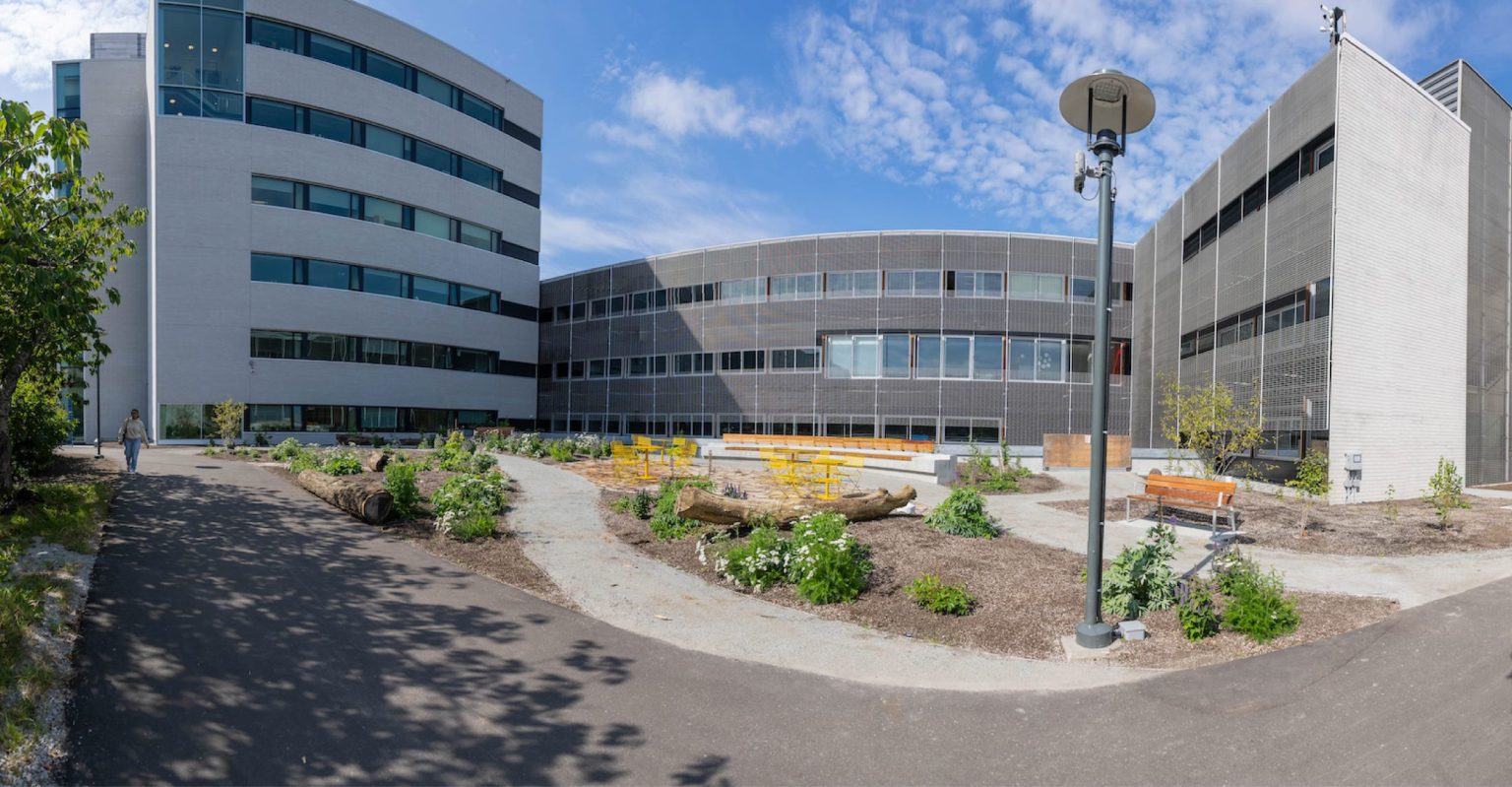
Case study: UBC Beaty Biodiversity Centre Addition
About This Project
The Beaty Biodiversity Centre Addition is a six-storey (plus basement) expansion of the Beaty Biodiversity Centre at the University of British Columbia (UBC). Designed by PUBLIC Architecture + Design, the addition provides much-needed space for expanding research and museum activities. New spaces include laboratories, research offices, administrative areas, storage (including a new below-ground fossil collection room), workshops, and meeting/collaborative spaces. The addition organizes laboratories on one side, offices on the opposite side, with a central service. The design is sensitive to the architectural language of the original building and aligns with UBC’s campus design principles.
Acoustic Challenge
Given the diverse range of spaces – including laboratories, private/shared offices, meeting rooms, workshops, and storage areas – each type of space presents distinct requirements for noise control and sound isolation.
To ensure suitable acoustic conditions across all functions, the design needed to address three primary criteria:
- Background noise levels from HVAC systems,
- Sound isolation between adjacent spaces, and
- Reverberation control appropriate to each space type.
These criteria were established by BKL based on the UBC Technical Guidelines (UBCTG), LEED v4.1, and applicable acoustical standards.
Scope of Services
As the acoustical consultant for the project, BKL Consultants provided acoustical design review services during the Schematic Design (SD) stage to help ensure the addition would meet the performance requirements of the UBC Technical Guidelines (UBCTG) and support the project’s pursuit of LEED v4.1 Gold certification.
BKL’s scope of work included:
- Overall acoustical design review: Assessing the acoustical requirements based on the function of each space type, including laboratories, offices, workshops, storage, collaborative areas, meeting rooms, and supporting spaces.
- Establishment of baseline project criteria: Defining background noise criteria (NC) per ASHRAE/LEED and UBCTG; sound isolation criteria between room types; and reverberation time (RT) limits according to UBCTG and LEED v4.1.
- Sound isolation design review: Reviewing the architectural coordination drawings and costing documentation to evaluate and recommend appropriate assemblies for demising walls, furring walls, doors, glazing, and penetrations (ducts, pipes) to achieve the required sound isolation. Special attention was given to limiting flanking noise and recommending adjustments to achieve the higher performances required for certain locations.
- Reverberation control recommendations: Proposing sound-absorbing treatments to control reverberation time in open areas, meeting rooms, and laboratories, ensuring speech clarity for communication.
- HVAC system guidance: Providing best-practice recommendations for controlling noise from mechanical systems, including induct mitigation measures, maximum airflow velocities in ducts, transfer duct design, and vibration isolation for equipment.
Project Benefits
Working with UBC Properties Trust and the broader design-build team, BKL’s proactive acoustical consulting delivered tangible benefits to the project:
- Supporting specialized functions: Ensured the acoustical environment in laboratories, research areas, and specimen storage meets the demanding requirements of specialized work, where concentration and precision are critical.
- Enhancing user experience: Created a comfortable working and visiting environment by controlling distracting noise and ensuring clear communication in collaborative spaces, meeting rooms, and exhibition areas.
- Facilitating sustainable certification: BKL’s recommendations were geared toward helping the project meet the necessary criteria to pursue and achieve the Acoustics credit under the LEED v4.1 Gold rating system, contributing to the building’s overall sustainability.
- Mitigating post-construction risk: By identifying potential acoustical issues early in the Schematic Design phase, BKL’s review helped the project team avoid costly post-construction retrofits and adjustments once the building was completed and occupied.
This expansion project builds on a long-standing relationship that began in 2010, when BKL served as the lead acoustical consultant for the original Beaty Biodiversity Centre and Museum. BKL’s familiarity with the facility’s specialized functions, combined with a deep understanding of existing conditions, enabled the delivery of well-integrated and effective acoustical solutions from the outset of the project.
Through this continued collaboration, BKL’s acoustical consulting helped ensure that the Beaty Biodiversity Centre Addition not only meets the functional demands of a world-class research and museum facility, but also provides a high-quality acoustic environment that supports UBC’s long-term vision – one that BKL has proudly for more than a decade.
Explore our case study on the original 2010 Beaty Biodiversity Centre & Museum project here.

Year Completed:
2025
Capital Cost
$45 million
Total Area
47,980 square feet