


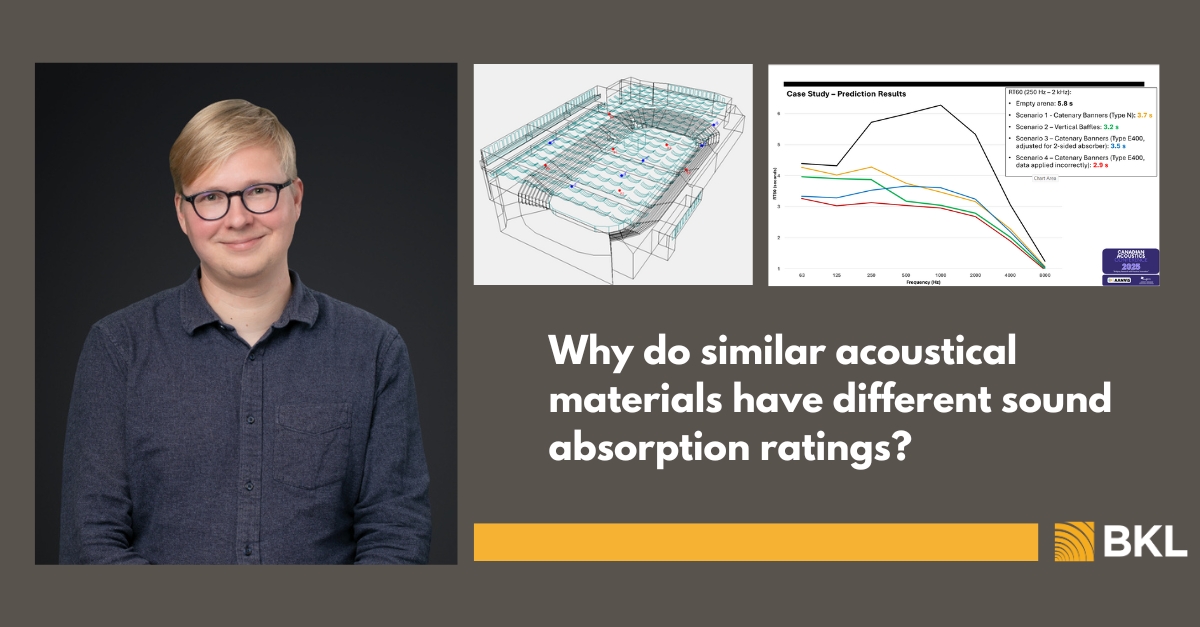
27 Nov Be Cautious with Sound Absorption Numbers: Hidden Pitfalls Every Facility Owner Should Know
A real-world story: When “perfect” NRC numbers turn out to be misleading
At first glance, those high NRC (Noise Reduction Coefficient) sound absorption ratings in product catalogues might seem like a guarantee of excellent sound absorption.
In a recent recreation facility project, a facility owner received quotes from multiple suppliers – one of which included inflated or inaccurate sound absorption data. BKL was then brought in to review and clarify the discrepancy.
This real-world case was shared by Joonas Niinivaara, Senior Acoustical Consultant at BKL, at the Canadian Acoustical Association’s 2025 Annual Conference (AWC2025). As Joonas explained, the problem wasn’t with the materials themselves – it was how the input data had been measured, calculated, and interpreted.
When BKL analyzed the issue, the cause became clear: the NRC data had been misunderstood and misapplied.
Why NRC Ratings Can Be Misleading
The Noise Reduction Coefficient (NRC) is a common indicator used to describe a material’s sound absorption performance – from wall panels and ceiling tiles to hanging baffles and acoustical clouds. All materials can be tested to determine their NRC rating, which is a value between 0 and 1. An NRC-rating of 0 indicates a fully sound-reflective surface (such as concrete or tile), whereas an NRC of 1 would describe a fully sound-absorptive material.
However, NRC ratings can sometimes be misleading because their accuracy depends on several technical factors that can be easily misunderstood or even overstated. There are even cases where manufacturers report NRC ratings that are above 1, i.e., more than 100% absorptive, which, of course, seems impossible. Read on, if you’re keen on finding out why this is!
Mounting Type – How the product was tested
According to ASTM E795, each product can be tested using different mounting configurations, which directly influences the results.
Common mounting examples include:
- Type A: Product mounted directly on a wall or ceiling – typical for wall panels.
- Type E400: Product suspended 400 mm from the ceiling, with the edges not visible.
- Type J: Product freely suspended – for baffles or acoustic clouds, absorbing sound on both sides.
- Type N: Product hung horizontally and allowed to sag – for catenary banners.
The same baffle, if tested in a “favourable” setup (absorbing from both sides or with a closed air space behind it), can appear to have a much higher NRC than it would in an actual installation.
Surface area used in the calculation
The NRC-rating is intended to describe the ratio of sound absorption for an area, and discrepancies occur when the product is a 3-dimensional absorber. Some manufacturers calculate NRC based on the area of one side of the absorber, ignoring the area of the sides and back, which effectively tends to double the NRC rating. Since the NRC-rating is relative to the area, this is how test results above 100% are obtained (i.e., the object absorbs more sound than the area that is assigned to it).
Riverbank Acoustical Laboratories, for example, notes that this method is intended for research purposes and should not be used for marketing claims.
Simulation software “Defaults”
Room acoustics modelling software such as ODEON or EASE may automatically apply absorption data to both sides of a floating surface (i.e., a cloud, baffle, or a catenary banner).
If the user doesn’t correct this, the predicted reverberation and overall acoustic performance will look better than what the real-world application is, and there is significant risk of undertreating the space with free hanging acoustically absorbing products.
Case Study: When Simulations Look Better Than Reality
In his presentation, Joonas Niinivaara shared a real case study from a recreation centre arena project.
The original design called for catenary banners, but vertical baffles were proposed by one supplier as a more cost-effective and flexible alternative.
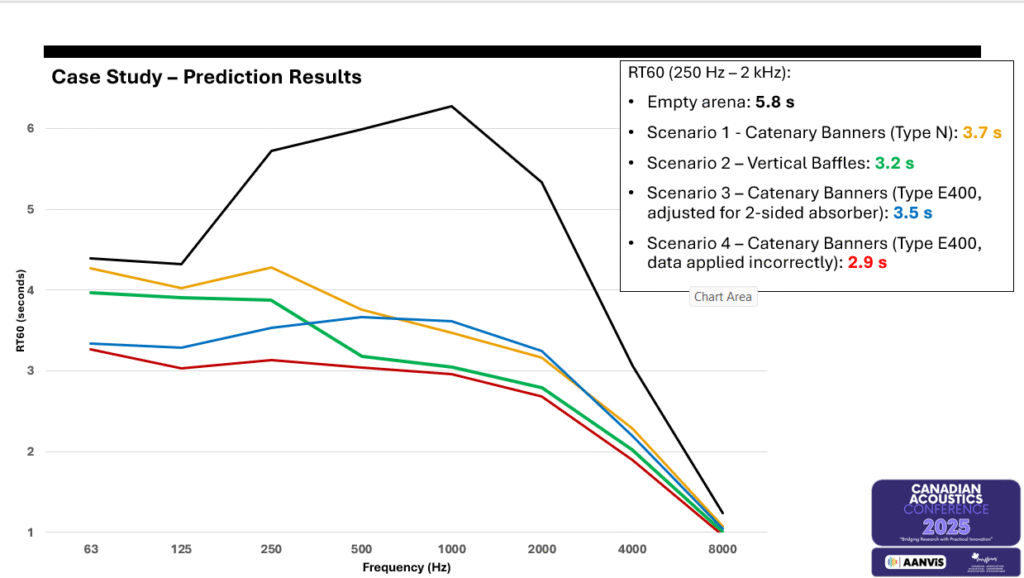
To understand how data interpretation affects design accuracy, the BKL team ran four simulation scenarios – all identical except using different NRC data inputs. The results showed how the same material can yield very different reverberation time (RT60) predictions depending on how the data was applied:
| Scenario | Material Type | Mounting / Test Data | Predicted RT60 (s) |
| 1 | Catenary banners | Type N | 3.7 |
| 2 | Vertical baffles | Type JV | 3.2 |
| 3 | Catenary banners | Type E400 (properly adjusted for two-sided absorber) | 3.5 |
| 4 | Catenary banners | Type E400 (incorrectly applied) | 2.9 |
Joonas explained that a difference of nearly one second between the correct and incorrect applications is significant. In practice, that 0.8-second gap can mean the difference between a clear, balanced acoustical environment and one that’s overly reverberant. Fixing such an error afterward, he noted, could be cost prohibitive.
Three Steps to Verify NRC Data Before You Trust It
You don’t have to be an acoustical consultant to spot unreliable data. For example, if an NRC-rating is above 1, be cautious! According to Joonas, by following these three simple checks, you can avoid most of the common NRC mistakes:
1. Ask for the original laboratory test report
Never rely solely on a marketing cut sheet or brochure.
A full test report shows:
- Which accredited lab performed the test (e.g., NRC-CAN, Riverbank, Orfield, Intertek);
- Which test standards were applied (ASTM C423, E795, etc.);
- And most importantly, which Mounting Type was used – the key factor that determines whether the NRC is valid for your installation.
If the mounting type isn’t mentioned, ask the manufacturer for the original report. A reputable supplier will always provide it.
2. Match the mounting type with the real installation
Once you understand how Mounting Type affects acoustical performance, it’s important to verify that the product data reflects how the material will actually be installed in your project.
A mismatch – for instance, using data from a two-sided baffle (type J) for a wall-mounted panel (type A) – can significantly alter predicted reverberation time (RT60).
3. Verify the surface area used in the calculation
One common error that inflates NRC results is using the wrong surface area.
If NRC is calculated based on one face only, divide the value by two or confirm with your acoustical consultant before entering it into a simulation.
As Riverbank Acoustical Laboratories advises, one-face calculations are intended for research purposes only and should not be used in marketing or design claims.
Lesson Learned: From Theory to Reality
In the recreation centre arena project, using accurate test data and understanding how each product behaves in real world conditions allowed the owner to compare products fairly and helped avoid the classic “it looked great on paper” problem after construction.
Not every NRC number tells the truth – what matters is how it was measured and applied.
BKL Consultants: Your Trusted Partner for Clarity
Joonas’ story at AWC2025 perfectly reflects BKL’s mission:
We don’t just deliver acoustical prediction reports – we deliver clarity and confidence behind every rating.
When you work with BKL, you gain a partner who can:
- Verify technical data from any supplier,
- Recommend the most cost-effective acoustic solutions, and
- Predict realistic performance to match your design intent.
Let’s build spaces that sound as good as they look – starting with data you can trust.
Quick FAQs
Q: How can I tell if the NRC data in a product catalogue is reliable?
A: Ask for the original lab report and verify the Mounting Type matches your site conditions.
Q: Does inaccurate NRC data affect other predicted acoustical parameters besides RT60?
A: Yes – it also affects other parameters such as early decay time (EDT), clarity (C50), and sound pressure levels (SPL).
Understanding your input data is the first step toward a successful acoustical design.
If you need help verifying product data, conducting acoustical simulations, or performing field measurements, our team of acoustical consultants at BKL is here to help.
👉 Contact us today.
Sorry, the comment form is closed at this time.