


21 Jul Teachers and Classroom Noise: An Often Overlooked Acoustical Consideration in School Design
Why Classroom Acoustics Matter for Teachers
When discussing noise in schools, most attention is focused on students – including background noise levels, speech intelligibility and learning outcomes. However, teachers are also directly and continuously affected by classroom acoustical conditions.
In many learning environments, particularly in spaces with high background noise levels or excessive reverberation, teachers are required to use their voices at elevated levels for extended periods in order to maintain communication with students. Over time, this can increase vocal loading, contribute to voice fatigue, and impact communication effectiveness in the classroom.
Acoustical Conditions and Vocal Strain on Teachers
Teachers are among the occupational groups at highest risk for voice-related disorders. Numerous studies have reported significantly higher rates of hoarseness, throat discomfort, and vocal fatigue among teachers compared with other professions.
One important contributing factor is classroom background noise. In environments with continuous noise, whether from HVAC systems, noise ingress from adjacent spaces, or the students themselves, teachers often need to raise their voices to communicate clearly.
Evidence shows that noisy classrooms often require teachers to speak at vocal levels that can lead to vocal stress and fatigue. In quieter classrooms, teachers can generally speak at more comfortable voice levels while still being heard throughout the room (Nelson et al. 2002). This highlights the importance of controlling background noise and reverberation as part of good classroom acoustical design.
Beyond personal health impacts, voice-related issues may also contribute to teacher absenteeism and operational challenges for schools. Voice disorders are considered one of the more common causes of work absence among teachers (Medeiros and Vieira 2019; Nerriere et al. 2009).
The economic impact is substantial. In the United States, voice-related issues among teachers have been estimated to cost approximately USD 2.5 billion annually (Rosow et al. 2016). These costs include medical treatment, sick leave, and indirect impacts on teaching quality.
The Impact of Noise in Classroom Communication
In classrooms with high background noise levels or excessive reverberation, speech clarity drops. Teachers experiencing vocal fatigue communicate less clearly, and instruction suffers.
This is particularly important for students who already experience difficulties processing auditory information. Research has shown that young children developing language skills, children with hearing or auditory processing difficulties, and students learning English as a second language may be more significantly affected by noisy environments (Erickson and Newman 2017).
In practice, when teachers must continuously increase their vocal effort to maintain communication, vocal fatigue may gradually affect speech clarity and vocal consistency, further reducing communication effectiveness in the classroom.
In some environments, this may lead to a feedback loop:
noisy classroom → teachers speak louder → vocal fatigue increases → communication quality declines → students struggle to understand → classroom noise increases further
Good acoustical design breaks this cycle at the source.
Common Sources of Classroom Noise
Student Activity and Noise Within the Space
Conversations, moving furniture, impacts between objects, and group activities are often major sources of classroom noise.
One study found that approximately 82% of teachers were affected by student-generated noise for at least one-quarter of their daily working time (Kristiansen et al. 2011).
A recent field study conducted in infant-toddler classrooms (under 36 months old) in Sydney, Australia, reported average noise levels of approximately 67 dBA when children were present, with some rooms exceeding 73 dBA (Degotardi et al. 2025).
Noise from Mechanical Systems or Adjacent Spaces
In addition to student activity, other noise sources can significantly affect classroom acoustics, including:
- HVAC systems (including fans and regenerated noise in ducted systems),
- projectors and electronic equipment,
- sound transmission from hallways or adjacent classrooms, and
- noise intrusion from road traffic or other environmental noise.
In many cases, this noise can affect speech clarity regardless of how quiet the students are.
Reverberation and Speech Clarity in Classrooms
In school acoustical design, reverberation time is an important factor influencing speech intelligibility.
Classrooms containing large amounts of reflective surfaces such as glass, concrete, hard flooring, or reflective ceilings exhibit longer reverberation times. This reduces speech clarity and increases perceived noise levels within the space.
Common approaches include:
- using acoustical ceiling systems
- adding sound-absorptive wall panels
- increasing sound-absorptive finishes
A study of early childhood classrooms in Australia (Degotardi et al. 2025) found that untreated classrooms had reverberation times of up to 1.5 seconds, while classrooms incorporating sound-absorptive materials averaged approximately 0.3 seconds. This five-fold reduction illustrates how room finishes can significantly influence reverberation and the overall acoustical environment.
Acoustical Standards for Schools
Currently, Canada does not have a nationally mandated acoustical standard specifically governing classroom acoustical performance. As a result, many Canadian school projects reference the joint American National Standards Institute (ANSI) and Acoustical Society of America (ASA) S12.60 together with other industry guidance as best-practice frameworks for developing classroom acoustical criteria.
ANSI/ASA S12.60 is the most widely referenced classroom acoustical standard in North America. The document recommends maximum background noise levels of 35 dBA for standard classrooms (room volume ≤ 283 cubic metres), together with reverberation time limits of 0.6 seconds for smaller rooms and 0.7 seconds for medium-sized rooms, along with sound insulation criteria between learning spaces.
These criteria are generally intended to support speech intelligibility in learning environments without requiring teachers to significantly increase vocal effort.
In addition to background noise control, the standard also includes recommendations related to:
- sound insulation between classrooms (minimum STC 50 between adjacent classrooms),
- hallway noise control, and
- reverberation time limits within classrooms.
Another standard, AS/NZS 2107 (2016) in Australia and New Zealand, provides similar recommendations, including background noise levels of approximately 35–40 dBA and reverberation time targets (RT60) of approximately 0.5–0.7 seconds depending on room volume.
In England, Building Bulletin 93 (BB93) serves as a mandatory regulatory document for all schools, with detailed acoustical requirements for various space types, including ambient noise, reverberation, sound isolation, impact noise, and even rain noise on lightweight roofs.
Strategies for Improving Classroom Acoustics
In practice, improving classroom acoustics often requires a combination of noise control and reverberation control strategies implemented together.
Reducing Reverberation Within the Space
Common approaches include:
- using acoustical ceiling systems with high sound absorption coefficients,
- adding sound-absorptive wall panels,
- increasing the proportion of sound-absorptive materials within the classroom, and
- limiting highly reflective surfaces where appropriate.
These strategies can help improve speech clarity and reduce perceived noise levels within classrooms.
Controlling HVAC Noise
HVAC systems are often among the most significant background noise sources in schools.
Mechanical noise control strategies may include:
- selecting lower-noise equipment,
- locating noisy equipment away from acoustically sensitive spaces,
- placing noise-generating equipment such as fans or VAV boxes away from classrooms, typically above corridors or in mechanical rooms,
- using acoustically lined ductwork or appropriate silencers, and
- limiting sound transmission between spaces through mechanical systems.
Improving Sound Isolation Between Spaces
Classroom sound isolation performance can be significantly affected by:
- gaps around doors,
- penetrations through walls,
- poor junction detailing, and
- crosstalk through ductwork.
In many cases, relatively minor improvements to detailing can substantially improve noise control between classrooms.
BKL – Practical Experience from School Projects
In practice, acoustical issues in schools often involve multiple interconnected factors, including:
- HVAC noise,
- sound transmission between classrooms,
- reverberation within spaces,
- vibration from mechanical equipment,
- and architectural layout conditions.
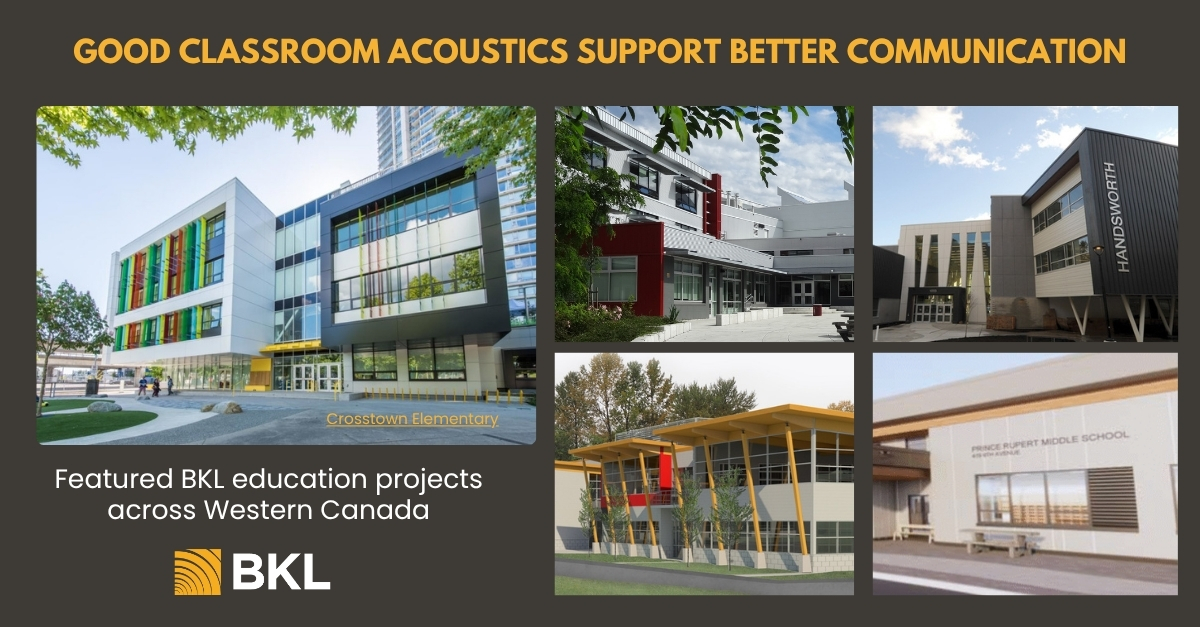
Through school projects across Western Canada such as École Beausoleil, Crosstown šxʷwəq̓ʷəθət Elementary School, Prince Rupert Middle School, Handsworth Secondary School, and Dámbü Tän Kets’ádań Kų̀ – Cliff Trail Elementary School, we have participated in a wide range of services related to:
- classroom acoustical treatment
- noise control
- sound isolation improvements
- environmental noise assessments
- vibration control for mechanical systems
Experience from these projects demonstrates that effective acoustical performance often depends on close coordination between architectural, MEP, constructor, and acoustical design teams from the early design stages.
Conclusion
Classroom noise affects not only students’ ability to concentrate and understand speech clearly, but also influences teachers’ vocal load, fatigue levels, and communication effectiveness.
Within educational environments, appropriate acoustical performance plays an important role in supporting speech intelligibility, reducing vocal strain, and improving the overall learning experience.
Many strategies for improving classroom acoustics can be implemented early in the design process, including HVAC noise control, reverberation reduction, improved sound isolation, and careful material selection.
Reverberation time has a direct impact on speech intelligibility and is often best understood through auditory demonstration. The following examples illustrate how changes in room acoustics influence perceived speech clarity across different acoustical conditions: Intelligible Design: Reverberation time and hearing
BKL Consultants Ltd. is a BC-based consulting firm specializing in acoustics, noise, and vibration. BKL has been supporting projects across markets, including the education sector, since 1966. Learn more and get in touch here.
References:
ANSI/ASA S12.60-2010/Part 1. 2010. Acoustical Performance Criteria, Design Requirements, and Guidelines for Schools, Part 1: Permanent Schools. Melville, NY: Acoustical Society of America.
AS/NZS 2107. 2016. Australia/New Zealand Standards AS/NZS 2107 Acoustics – Recommended Design Sound Levels and Reverberation Times for Building Interiors. Sydney: Standards Association of Australia.
Degotardi, Sheila, Mridula Sharma, and Janice Ng. 2025. “Noise Levels in Infant-Toddler Early Childhood Classrooms: Individual Variation and Relationships with Social and Physical Features of the Room.” Australasian Journal of Early Childhood 50 (3).
Erickson, L. C., and R. S. Newman. 2017. “Influences of Background Noise on Infants and Children.” Current Directions in Psychological Science 26 (5): 451–457.
Jónsdottir, V., A. M. Laukkanen, and I. Siikki. 2003. “Changes in Teachers’ Voice Quality During a Working Day With and Without Electric Sound Amplification.” Folia Phoniatrica et Logopaedica 55 (5): 267–280.
Kristiansen, J., S. P. Lund, P. M. Nielsen, R. Persson, and H. Shibuya. 2011. “Determinants of Noise Annoyance in Teachers From Schools With Different Classroom Reverberation Times.” Journal of Environmental Psychology 31 (4): 383–392.
Medeiros, A. M. D., and M. D. T. Vieira. 2019. “Work Absenteeism Due to Voice Disorders in Brazilian Schoolteachers.” Cadernos de Saúde Pública 35.
Nelson, P. B., Soli, S. D., & Seltz, A. (2002). Classroom Acoustics II: Acoustical Barriers to Learning. Acoustical Society of America.
Rosow, D. E., M. Szczupak, S. Saint-Victor, J. D. Gerhard, C. DuPont, and K. Lo. 2016. “The Economic Impact of Vocal Attrition in Public School Teachers in Miami-Dade County.” The Laryngoscope 126 (3): 665–671.
Sorry, the comment form is closed at this time.